
Overview
Schedule A litigation refers to cases where intellectual property owners sue multiple online sellers identified in a sealed attachment to the Complaint (the “Schedule A”). As noted by Judge Durkin in Roblox Corp. v. Bigfinz, 2023 WL 8258653 (N.D. Ill. Nov. 29, 2023), Schedule A filings are permitted “because . . . it is the most efficient way to address the epidemic of counterfeit goods being sold in the United States on the internet by defendants located outside the United States.”
The structure of a typical Schedule A case enables plaintiffs to seek early ex parte relief, including financial account freezes and orders that direct payment processors and marketplaces to disable storefronts, including those operated from outside of the U.S. In many cases, defendants never appear, thereby allowing plaintiffs to leverage default judgments that include permanent injunctions (e.g., disabling defendants’ accounts and/or advertisements with respect to counterfeiting goods on major e-commerce platforms) and substantial statutory damages (e.g., $50,000-250,000 per defendant).
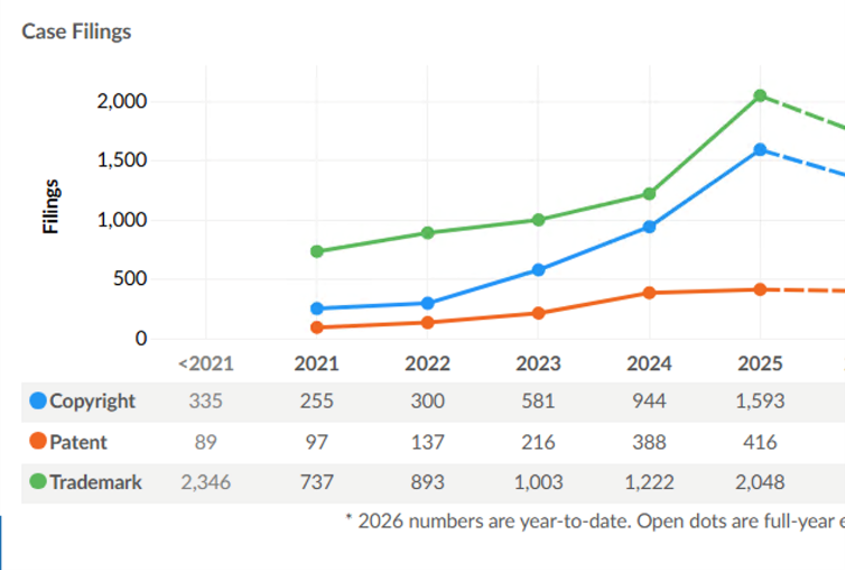 | 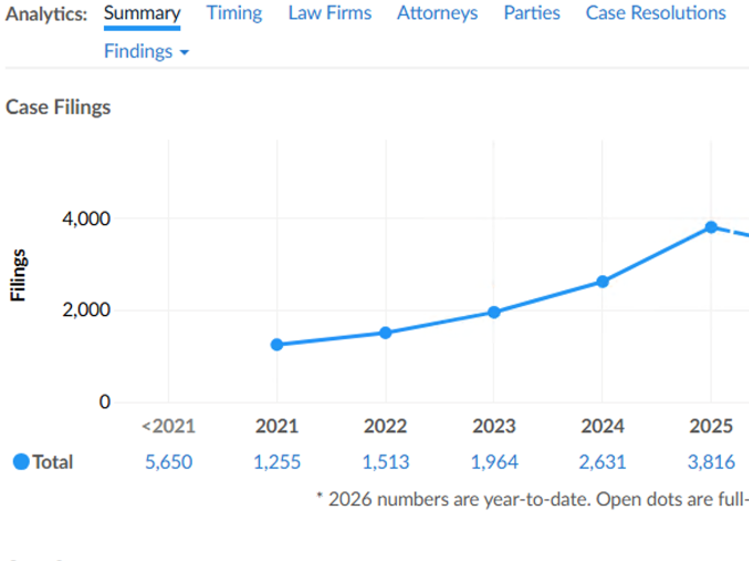 |
According to LexMachina, the total number of Schedule A cases has grown steadily year over year, with trademark cases, especially counterfeiting claims under the Lanham Act, representing the overwhelming majority.
While the Northern District of Illinois has emerged as the epicenter of Schedule A litigation, Schedule A cases are not limited to a single jurisdiction. Each year, the number of Schedule A cases filed in different courts across the United States continues to rise.
The widespread rise of Schedule A cases in recent years has engendered critiques, particularly within the academic community. Much of the criticism centers on the tension between the mechanics of Schedule A cases and the traditional framework of the Federal Rules of Civil Procedure, as well as the constitutional guarantees of due process. For example, Professor Eric Goldman of Santa Clara Law School has observed that “[t]he SAD[1] Scheme capitalizes on weak spots in the Federal Rules of Civil Procedure, judicial deference to IP rightsowners, and online marketplaces’ liability exposure.” Additionally, Professor Sarah Fackrell of Chicago-Kent College of Law asserts that “everyone has a constitutional right to due process, even if they are counterfeiters.” The debate relevant to trademark cases frequently concerns the following four aspects:
- Personal jurisdiction. It is disputed whether specific personal jurisdiction can be established only based on a defendant’s online activities and/or a single purchase. In particular, courts have increasingly scrutinized whether such allegations establish “purposeful availment” by the defendant, particularly when defendants are foreign sellers operating through third-party online marketplaces (e.g., Amazon, eBay), without otherwise targeting the forum state.
- Rule 65 ex parte relief. Scholars and courts in Schedule A cases have increasingly examined the sufficiency of plaintiffs’ efforts to establish particularized facts that would warrant ex parte relief in Schedule A cases as required under Fed. R. Civ. P. 65(b)(1)(A).
- Service of process under Rule 4(f). While numerous courts (including the Seventh Circuit) have held electronic service of process on foreign defendants is permissible under Fed. R. Civ. P. 4(f)(3) (especially when physical addresses are not available), some courts have denied relief when plaintiffs have not even attempted to comply with the Hague Service Convention’s requirements.
- Joinder under Rule 20(a). In the landmark case of Bose Corporation v. Partnerships and Unincorporated Associations Identified on Schedule “A,” 334 F.R.D. 511 (N.D. Ill. Feb. 19, 2020), Judge Durkin noted that “[s]eeking relief against each member of the swarm one by one defies common sense, because it is the swarm—the fact that all Defendants are attacking at once—that is the defining aspect of the harm from which Bose seeks relief.” Indeed, courts generally permit joinder where plaintiffs plausibly allege coordinated activity among defendants. More recently, however, courts have increasingly rejected the proposition that common ownership of an intellectual property right, combined with similar online conduct, is sufficient to satisfy this standard.
Recent judicial scrutiny, much of it informed by academic criticism, has not resulted in less Schedule A litigation, but, rather, it has narrowed the scope and circumstances under which it can be pursued successfully.
Overall, Schedule A litigation continues to present one of the most cost effective and efficient ways for brand owners to combat online counterfeiting, although judicial pushback has increased the importance of being strategic rather than blunt in their filing. For defendants with valid defenses who may find themselves inappropriately lumped together with bad actors, the judicial questioning of the typical Schedule A playbook represents a welcome opportunity to be heard.
[1] According to Professor Goldman, the “SAD Scheme” stands for “Schedule A Defendants Scheme.”
Professionals
Peter Sloane
Partner
Vera Glonina
Associate