
Overview
This article appeared in The Newtonian, Issue #41, Autumn 2026
Design patents on massage roller devices provided the setting for the Federal Circuit’s recent consideration of how much of a design patent infringement case may be resolved by the court rather than the jury. On August 11, 2026, the court denied panel rehearing and rehearing en banc, leaving in place a panel ruling affirming summary judgment of noninfringement. The denial preserved a precedential decision that gives district courts significant room to narrow a design patent’s scope based on functionality and to find accused designs plainly dissimilar as a matter of law. Range of Motion Prods., LLC v. Armaid Co., No. 2023-2427, slip op. (Fed. Cir. Aug. 11, 2026) (order denying panel rehearing and rehearing en banc).
What Standards Govern Design Patent Infringement?
Two strands of design patent doctrine drove the dispute.
First, design patent infringement turns on whether an ordinary observer, familiar with the prior art, comparing the claimed and accused designs would view them as substantially the same. Gorham Co. v. White, 81 U.S. 511 (1871); see also Egyptian Goddess, Inc. v. Swisa, Inc., 543 F.3d 665 (Fed. Cir. 2008) (en banc). In Egyptian Goddess, the Federal Circuit added that “[i]n some instances, the claimed design and the accused design will be sufficiently distinct that it will be clear without more that the patentee has not met its burden of proving the two designs would appear ‘substantially the same’ to the ordinary observer, as required by Gorham.” Egyptian Goddess, 543 F.3d at 678 (citing Gorham v. White, 81 U.S. 511). That sentence became a central point of disagreement in Range of Motion.
Second, courts construe design patent claims before they are compared to the accused design. Current Federal Circuit law permits courts to identify functional aspects for exclusion from the infringement comparison. In doing so, courts may consider evidence such as concomitant utility patents, inventor testimony, and utility-focused advertising. See OddzOn Prods., Inc. v. Just Toys, Inc., 122 F.3d 1396 (Fed. Cir. 1997); Richardson v. Stanley Works, Inc., 597 F.3d 1288 (Fed. Cir. 2010); Sport Dimension, Inc. v. Coleman Co., 820 F.3d 1316 (Fed. Cir. 2016); and PHG Techs., LLC v. St. John Cos., 469 F.3d 1361 (Fed. Cir. 2006).
What Happened in Range of Motion v. Armaid?
Range of Motion Products, LLC (“RoM”) owned U.S. Design Patent No. D802,155 (the “D’155 Patent”), titled “Body Massaging Apparatus” and embodied in RoM’s “Rolflex” device.
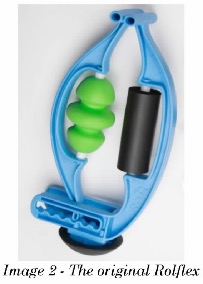
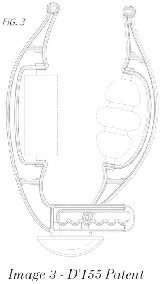
Range of Motion Prods. LLC v. Armaid Co., No. 1:22-cv-00091-JDL, 2023 WL 5530768, at *3–5 (D. Me. Aug. 28, 2023).
The Armaid Company Inc. (“Armaid”) sold the “Armaid2,” which was accused of infringing RoM’s D’155 Patent.
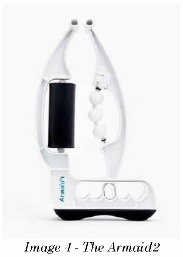
Id. at *5.
The same designer, Terry Cross, created the earlier Armaid1, which was covered by U.S. Patent No. 5,792,081, a limb-massager utility patent. The parties treated Armaid1 and the ’081 utility patent as the relevant prior-art reference for the infringement analysis. Cross later adapted aspects of that design into RoM’s Rolflex, while Armaid sold the accused Armaid2.
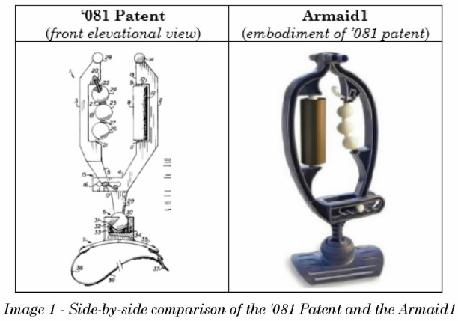
Id. at *2.
The district court concluded that many claimed features of the D’155 Patent were driven by function, making the overall scope of the design claim “accordingly narrow.” Id. at *7–8. That conclusion rested on three categories of evidence outside the asserted design patent. First, the prior-art ’081 utility patent claimed arms “shaped and dimensioned to adjustably clamp a limb.” Second, Cross submitted an affidavit identifying functional changes, including “the overall clamshell appearance of the arms,” that enabled full-body use. Third, RoM’s marketing described how the Rolflex product’s “clam-shaped roller arms [provided] significant leverage.” Id. at *8. Comparing the narrowed claim to the accused product, the court found the designs “plainly dissimilar.” Id. at *10–11.
How Did the Federal Circuit Panel Rule?
A divided panel affirmed on February 2, 2026. Range of Motion Prods., LLC v. Armaid Co., 166 F.4th 981 (Fed. Cir. 2026). The panel agreed that the shape of the arms was functional and rejected RoM’s contention that solid lines identified ornamental subject matter while broken lines identified functional subject matter. Range of Motion, 166 F.4th at 993. Chief Judge Moore dissented. RoM petitioned for rehearing, five amici filed briefs, and the court declined rehearing.
Judge Cunningham, joined by Judge Hughes, concurred in the denial. The concurrence reasoned that assessing whether two designs are substantially the same necessarily accounts for both similarities and differences, citing the Supreme Court’s statement in Gorham that the controlling consideration is “the resultant effect.” Range of Motion, No. 2023-2427, slip op. at 2. The concurrence read the disputed Egyptian Goddess sentence—that some claimed and accused designs may be so “sufficiently distinct” that noninfringement is “clear without more”—as identifying a category of cases in which no ordinary observer could be deceived. If district courts resolve genuine disputes of material fact under that label, the concurrence added, the remedy would be reversal on appeal rather than revision of the standard. Slip op. at 2–3.
What Did the Dissent Argue?
Chief Judge Moore, joined by Judge Reyna, dissented; Judges Stoll and Stark dissented without opinion. The dissent first argued that a design patent is a series of pictures, not a written instrument. For that reason, the Markman rationale for assigning claim construction to the court does not fit as well. The dissent also noted that functionality is a jury question for trade dress and, indeed, design patent validity. It saw an inconsistency in treating the same functionality inquiry, guided by the same PHG factors, as a legal issue when labeled claim construction. Slip op. at 5–8. Design patent claim construction, the dissent stated, “is nearly all fact,” and the findings here were based “primarily on a concomitant utility patent,” an inventor affidavit, and marketing materials—none of which appears in the asserted patent. Slip op. at 11–12. The second objection is that the district court’s “plainly dissimilar” and “sufficiently distinct” formulations reframed the inquiry from similarity to difference. The dissent pointed to an amicus survey, recounted in its panel dissent, in which more than sixty percent of people participating in the survey who were shown designs from cases finding infringement called them plainly dissimilar. Slip op. at 15 (citing Range of Motion, 166 F.4th at 995–96). The dissent, therefore, would allocate aesthetic appearance, ornamentality, and functionality to the jury. Slip op. at 16.
What Does This Mean for Design Patent Owners?
The rehearing denial leaves the panel decision precedential.
In a separate nonprecedential decision, the Federal Circuit affirmed denial of a preliminary injunction involving a handbag hanger design patent after the district court identified functional elements, focused on the remaining ornamental features, and found that the accused product was not likely to deceive an ordinary observer. Jacki Easlick, LLC v. CJ Emerald, Nos. 2024-1538, 2024-1826, slip op. (Fed. Cir. Aug. 14, 2026) (nonprecedential). Although nonprecedential and procedurally different, Jacki Easlick reinforces the practical force of Range of Motion: functionality filtering and an insufficient evidentiary showing can defeat design patent relief early.
References
Range of Motion Prods., LLC v. Armaid Co., No. 2023-2427, slip op. (Fed. Cir. Aug. 11, 2026) (order denying panel rehearing and rehearing en banc).
Gorham Co. v. White, 81 U.S. 511 (1871).
Egyptian Goddess, Inc. v. Swisa, Inc., 543 F.3d 665 (Fed. Cir. 2008) (en banc).
OddzOn Prods., Inc. v. Just Toys, Inc., 122 F.3d 1396 (Fed. Cir. 1997).
Richardson v. Stanley Works, Inc., 597 F.3d 1288 (Fed. Cir. 2010).
Sport Dimension, Inc. v. Coleman Co., 820 F.3d 1316 (Fed. Cir. 2016).
PHG Techs., LLC v. St. John Cos., 469 F.3d 1361 (Fed. Cir. 2006).
Range of Motion Prods. LLC v. Armaid Co., No. 1:22-cv-00091-JDL, 2023 WL 5530768 (D. Me. Aug. 28, 2023).
Range of Motion Prods., LLC v. Armaid Co., 166 F.4th 981 (Fed. Cir. 2026).
Markman v. Westview Instruments, Inc., 517 U.S. 370 (1996).
Jacki Easlick, LLC v. CJ Emerald, Nos. 2024-1538, 2024-1826, slip op. (Fed. Cir. Aug. 14, 2026) (nonprecedential).
Industries
Professionals
Robert Isackson
Partner
Dexter Chang
Counsel